Projects
A Project in Flowize is an isolated workspace used to organize and manage related automation assets, including flows, integrations, triggers, storage, app connections, conditions, content, and project-level settings. Projects are organized into Project Groups, which control which users can see and access each project.
Open a project
Only Project Admin and Full Admin roles can create and manage projects.
If you already have projects in your workspace, you can open one from My Work in the Latest projects area or from the Projects menu, otherwise check how to create your first project in this article Create your first project
After you open a project, you can access its flows, resources, settings, and related configurations.
To identify a project without opening it, select the information icon next to it in the Projects menu. The card shows the project name and ID, along with storage and worker information.
Project settings
Full Admins and Project Admins can manage project settings. Open a project and select Settings under Manage. Choose General settings, Data Management, Dashboard, or Advanced options from the settings menu. Select Save in the upper-right corner after changing settings.
In an environment, the settings menu also includes File access for managing the project's SFTP access.
General settings
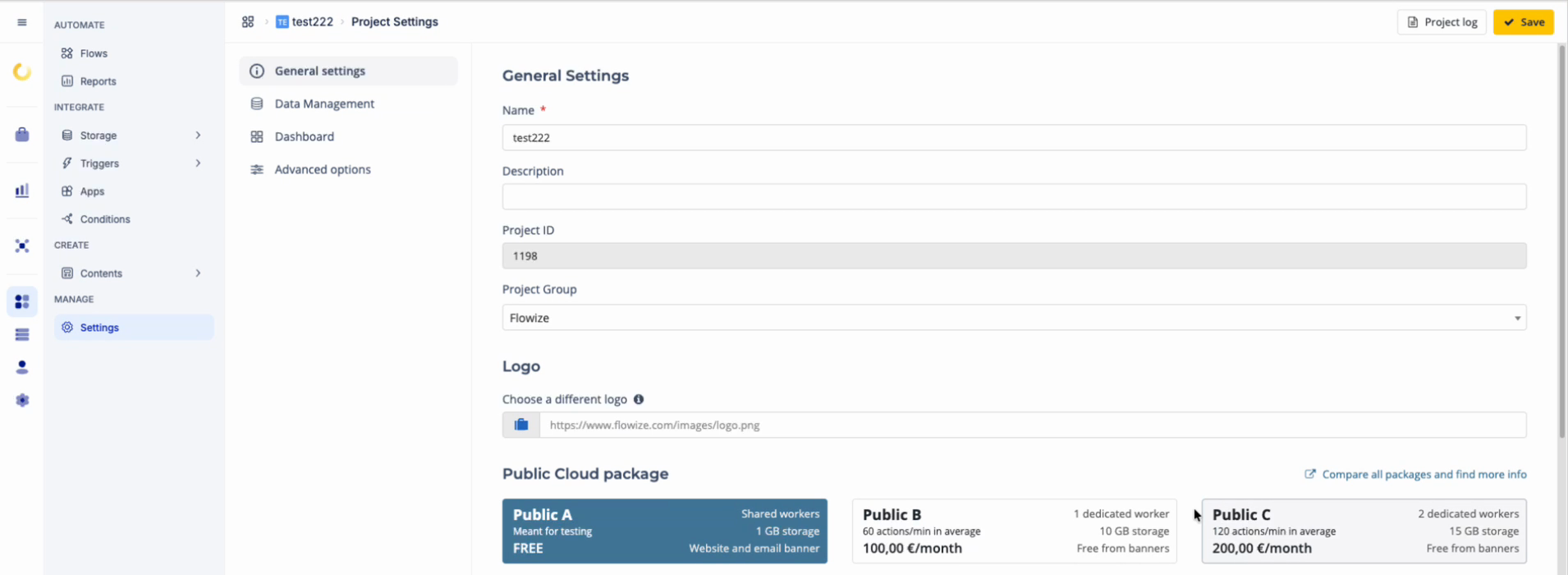
Use General settings to review and update the project's basic information:
- Edit the required Name, add a Description, or choose a different Project Group. The Project ID is displayed for reference and cannot be edited here.
- Under Logo, choose a different project logo.
- Review the selected Public Cloud package and the other available packages. Select Compare all packages and find more info for package details. To change packages, see Change a Project's Public Cloud package.
- Review the Custom Project Domains table for the Web and API endpoints, and IP Addresses for the project's listed IPs.
The API Key is hidden by default. To view it, select the eye icon beside API key, enter your password in the confirmation dialog, and select Show. The key is shown temporarily.
To save a project backup, go to Export Project and select Download. Exporting can take several minutes if the project has many files in File Manager. For the export's scope and how to use it to create a new project, see Export and import projects.
Data Management
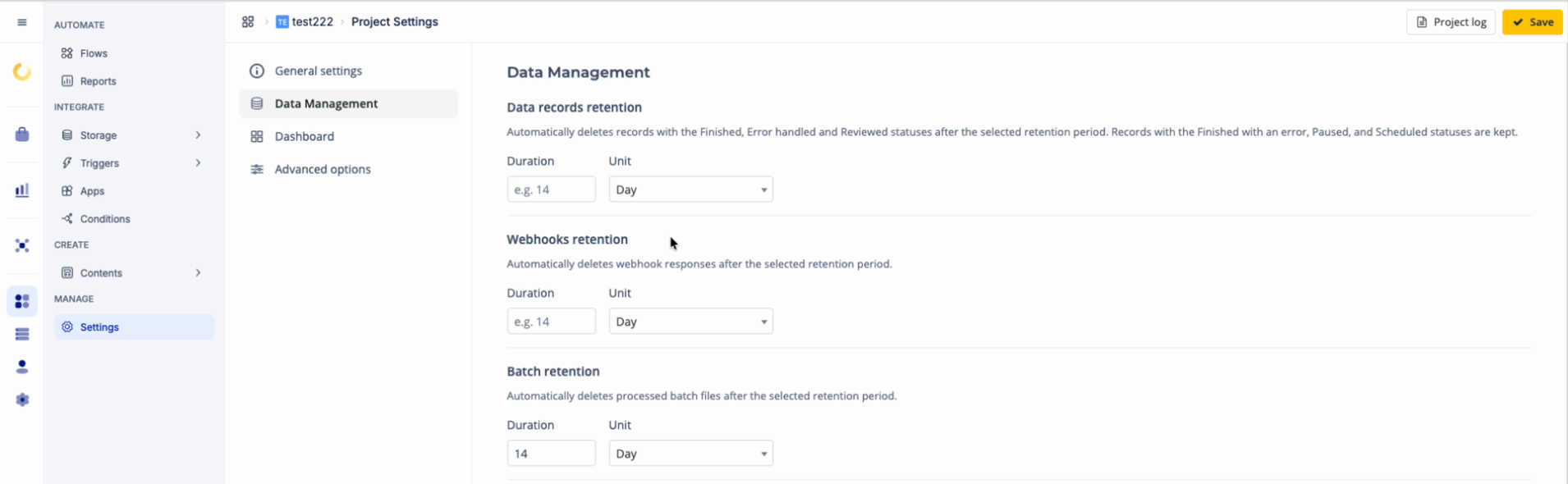
Use Data Management to set a Duration and Unit for each retention period:
- Data records retention automatically deletes records with Finished, Error handled, or Reviewed status after the selected period. Records with Finished with an error, Paused, or Scheduled status are kept.
- Webhooks retention automatically deletes webhook responses after the selected period.
- Batch retention automatically deletes processed batch files after the selected period.
To delete data for a specific date range, turn on Delete My Data reports, Delete Webhook responses, or both under Delete specific data. Enter both From and To dates, then select Delete. The date range is required before the deletion can proceed.
For retention rules, preserved statuses, and the deletion procedure, see Data retention and cleanup.
File access
In an environment, open File access to enable or disable SFTP access. When access is enabled, download the private key and use the displayed connection details to connect an SFTP client to the project's sftp folder in File Manager.
Enabling or disabling access restarts the environment's SFTP service and may interrupt transfers in other projects. For connection steps and the effects of disabling or re-enabling access, see Project SFTP access.
Dashboard
Under Dashboard, enter comma-separated IPv4 or IPv6 addresses in Whitelist IPs to specify where the Data Dashboard URL can be accessed from. The page displays the project's dashboard URL.
You can add URL parameters to filter the dashboard results:
intervalsets the time range. The default is2M(two months); examples include2Y,3M,8D, and2W.typeselectserrorsorrunning. If omitted, the dashboard shows both types.
For example, append ?interval=3W&type=errors to the displayed URL to show errors from the last three weeks.
Advanced options
Under Advanced options, use Flow options to set Number of Flow Retries and Minutes to wait on Flow error. The page also displays Maximum times an App can be executed and the Batch options Upload size limit; these fields are displayed as read-only.
In an environment, Flow options also includes Single thread mode? to run records one at a time. For retry behavior, App-specific error handling, single-thread mode, and upload limits, see Project execution settings.
Project log
Use Project log to review recorded user activity for a project. Content Editors, Project Admins, and Full Admins can view the log for projects they can access. See Roles and restrictions for more about project access.
Search the project log
- Open the project and select Settings under Manage. To review activity in an environment, open the project in that environment first.
- Select Project log in the upper-right corner of the settings page.
- Select Search to open Find in the logs.
- Enter the filters you need, then select Search in the dialog.
All search fields are optional:
| Filter | How to use it |
|---|---|
| Email/Username | Enter the beginning of the user's recorded email address or username. |
| Full Name | Enter text contained anywhere in the user's recorded full name. |
| Date: From: and To: | Choose dates with the date picker, or enter them in the format shown in the fields. The range includes both selected days. |
If you fill in both Email/Username and Full Name, the results include entries matching either field within the date range.
If From: is blank, the search starts at the beginning of the day 30 days ago. If To: is blank, it ends at the end of today. A date that cannot be read uses the same default for that field. To find older activity, set an explicit date range.
Select Reset search to clear the filters and return to the default date range, from 30 days ago through today.
If the page displays No project logs found, check that you opened the correct project and environment. Review the date range and identity filters, or select Reset search to try the default search.
Read project log entries
Entries appear newest first by default.
| Column | What it shows |
|---|---|
| Created | The entry's date and time, using your account's display formats. |
| Username | The email address or username recorded for the user. |
| Full name | The user's recorded full name. |
| Action | The area and action recorded, such as Flow - Publish. |
| Entity | The affected item's name or another available identifier, followed by its ID in parentheses. |
| Params | Additional recorded details about the item. This column can be blank. |
Select Created, Username, or Full name to change the sort order. Use Items per page and the page controls to browse longer logs.
For a flow's change and publication notes, see Flow change history.
Delete a project
Only Project Admin and Full Admin roles can delete projects.
- Open the project and select Settings under Manage.
- In General settings, scroll to Delete Project and select Delete.
- In the confirmation dialog, type
DELETE, then select Delete again.
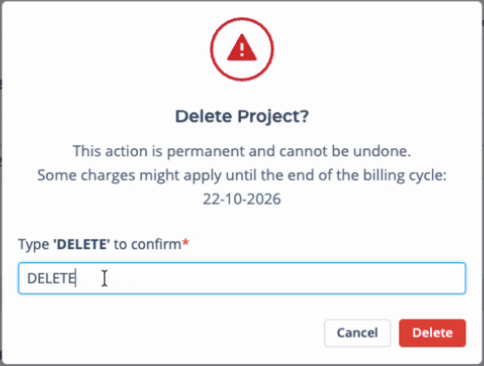
Deleting a project is permanent, and its associated data cannot be recovered. Charges may continue until the end of the current billing cycle.
Was this article helpful?